Аукцион Bidspirit | Labas A. A.
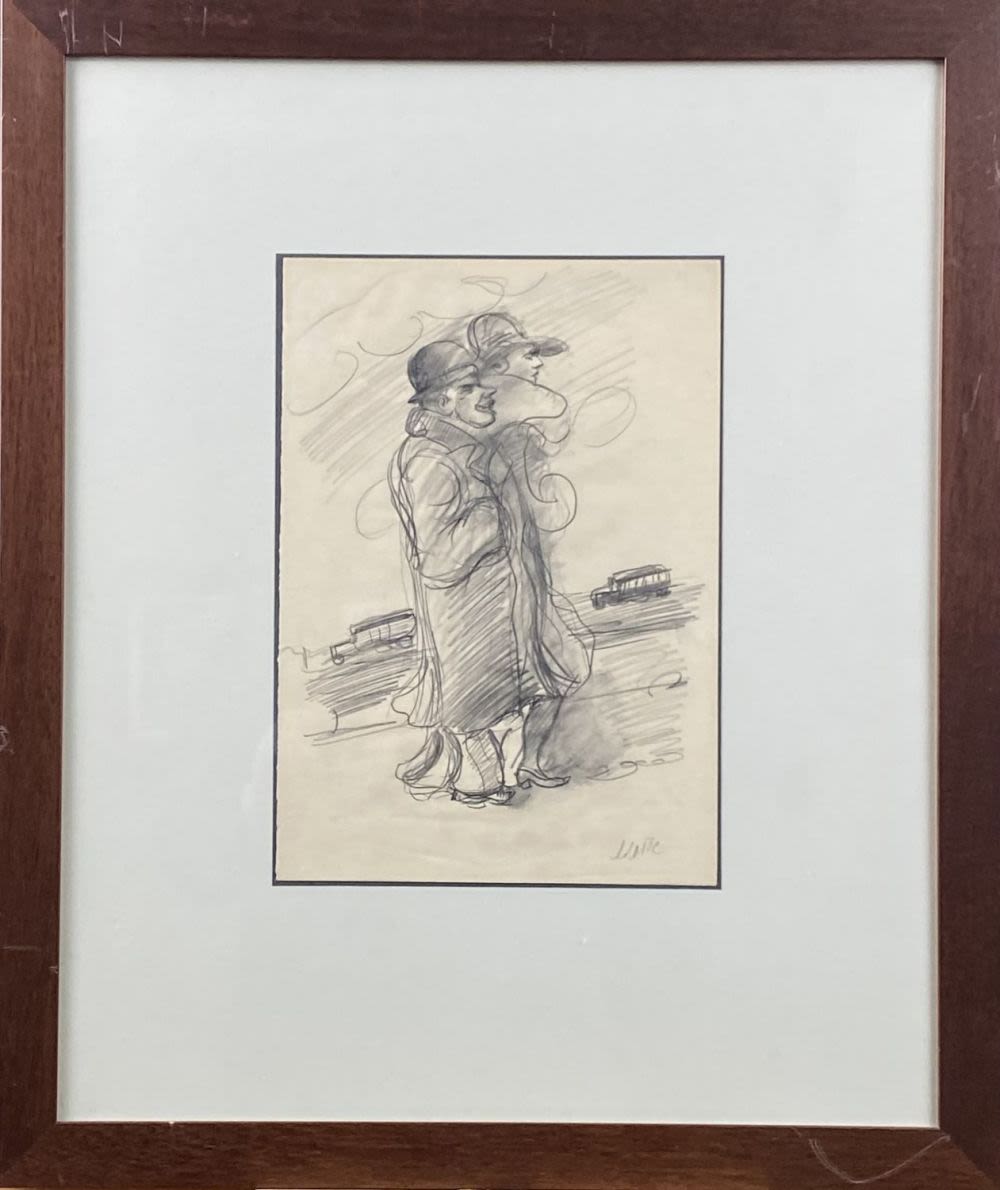
Labas A. A. - Pair.. 1960-70s. 29x20.5 cm. Paper, graphite pencil. Comes from the collection of A. Zavolokin. Labas Alexander Arkadyevich (1910-1983) –– studied at the STSHPU (1912–1918) with D.A. Shcherbinovsky, F.F. Fedorovsky, in the studio of F.I. Rerberg (1915), the Studio of Painting and Drawing of I.I. Mashkov (1916), GSHM (1918–1919) by P.P. Konchalovsky. In 1919 he volunteered for the front and worked under the Political Directorate of the 3rd Army of the Eastern Front. In 1920–1922 – professor at the Yekaterinburg State Agricultural Academy. Upon returning to Moscow, he continued his studies at Vkhutemas (1922). In 1925–1929 he taught painting and color science at Vkhutemas-Vkhutein. In 1921 he became a member of the Method group, working on abstract geometric compositions exploring the interactions of static and dynamic elements that embody cosmic order (“Color Composition”. 1920–1921. Private collection). In 1924 she abandoned pure non-objectivity, assimilating her experience in figurative art (“City Square”. 1926. PGKG). Since the second half of the 1920s, a characteristic series of “characters” has emerged: trains, airplanes, airships, the main motives of the works are movement and speed, a new experience of time through the utopias of the early 20th century and romanticized scientific and technological progress, the main object of aesthetic knowledge is the infinity of the transforming spatial matter, prolonging the futuristic concept of plastic dynamism (“In the cockpit of an airplane.” 1928. Tretyakov Gallery; “In the evening on the way to the airfield.” 1928. Tretyakov Gallery; “October.” 1928. Tretyakov Gallery; “The train is coming.” 1929. State Russian Museum; “Dirigible” 1931. State Russian Museum; “In Flight”, 1935. Tretyakov Gallery). In the 1930s, a lyrical version of the utopian design of aero cities was born in monumental panels for the Moscow House of Pioneers. Since the late 1950s, Labas has again turned to non-objective creativity, reproducing lost works of the 1920s (“Composition on a gray background.” 1978. Private collection) and developing new forms of synthesis of the mimetic and abstract, inheriting the theories of V.V. Kandinsky in the comparison of painting and music (“Fantastic Landscape”. 1973; “Orchestra”. 1981. Both are private collections). Creating a science-fiction cosmogony, he studies the primary elements of existence, comprehending the mechanisms of the Universe through the continuous degeneration of its “substance” from materiality to speculativeness. Reflections on the forms of self-realization of the universe are embodied in the series “Inhabitants of Distant Planets” (1968–1976), which anticipates the poetics of postmodernism in the quotation of artistic text and the ironic reconstruction of total “intergalactic” historicism.