Аукцион Bidspirit | BRETON ANDRE: (1896-1966)
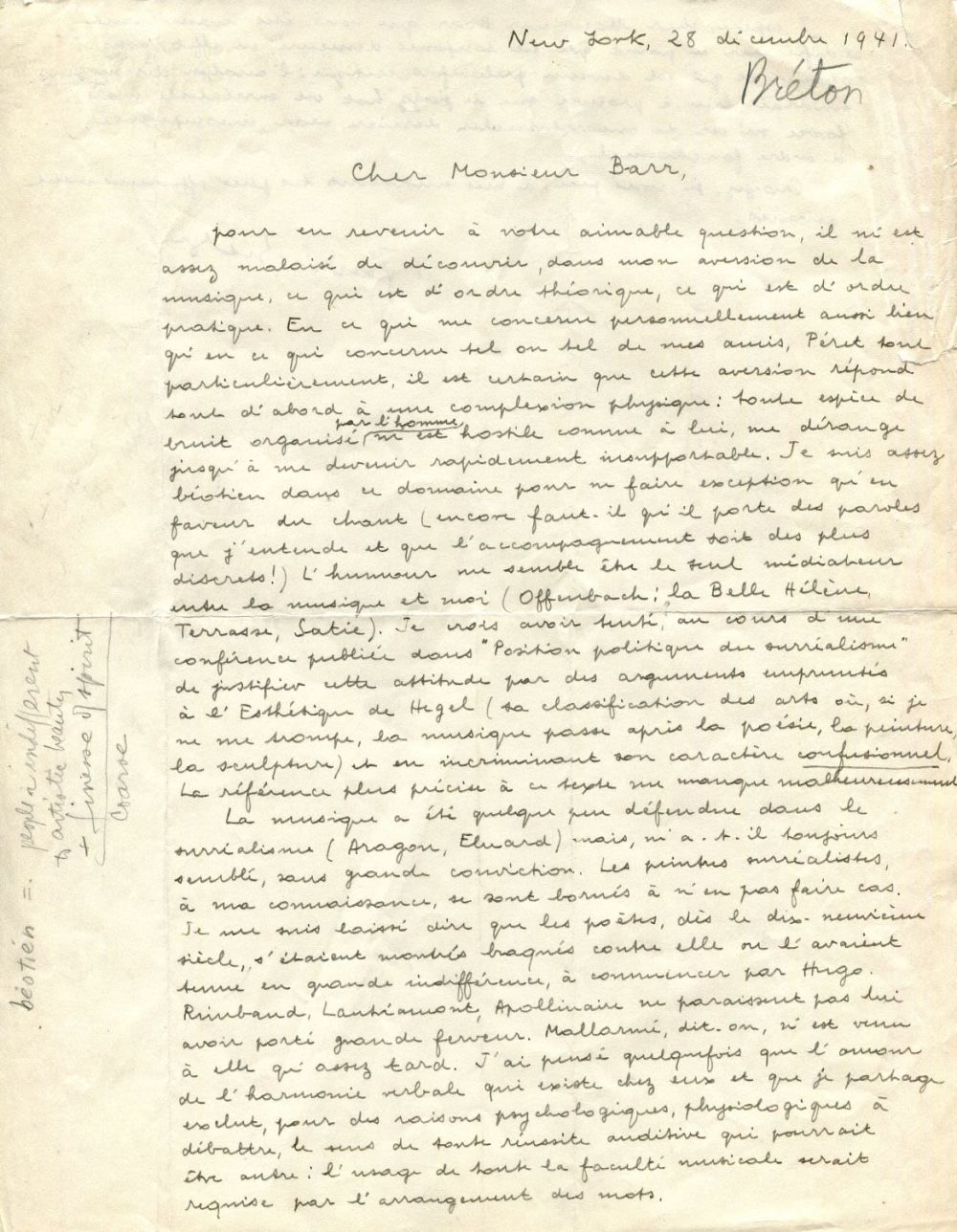
BRETON ANDRE: (1896-1966) - BRETON ANDRE: (1896-1966) French writer and poet, the co-founder, leader and principal theorist of surrealism. An important A.L.S., Andre Breton , two pages, 4to, New York, 28 th December 1941, to [Alfred] Barr, in French. Breton writes in response to Barr’s question on the subject of music (or, the lack of it) within surrealism, in part, ‘il m'est assez malaise de decouvrir, dans mon aversion de la musique, ce qui est d'ordre theorique, ce qui est d'ordre pratique. En ce qui me concerne personnellement aussi bien qu'en ce qui concerne tel ou tel de mes amis, Peret tout particulierement, il est certain que cette aversion repond tout d'abord a une complexion physique: toute espece de bruit organise par l'homme m'est hostile comme a lui…… Je suis assez beotien dans un domaine pour ne faire exception qu'en faveur du chant (encore faut-il qu'il porte des paroles que j'entende et que l'accompagnement soit des plus discrets!)…… Je crois avoir tente, au cours d'une conference publiee dans ”Position politique du surrealisme” de justifier cette attitude par des elements empruntes a l'Esthetique de Hegel (sa classification des arts ou, si je ne me trompe, la musique passe apres la poesie, la peinture, la sculpture)…… La musique a ete quelque peu defendue dans le surrealisme (Aragon, Eluard) mais, m'a-t-il toujours semble, sans grande conviction. Les peintres surrealistes, a ma connaissance, se sont bornes a n'en pas faire cas. Je me suis laisse dire que les poetes, des le XIX siecle, s'etaient montres braques contre elle ou ne l'avaient tenue qu'en grande indifference, a commencer par Hugo, Rimbaud, Lautreamont, Apollinaire ne paraissent pas lui avoir porte grande faveur.......J'ai pense quelquefois que l'amour de l'harmonie verbale qui existe chez eux et que je partage exclut, pour des raisons psychologiques a debattre, le sens de toute reussite auditive…… J'espere, cher Monsieur Barr, que vous etes maintenant edifie sur ce point qui est toujours demeure, en effet, assez obscur et qui est devenu quelquefois critique: l'analyse des moyens tendrait bien a prouver que le jazz hot est surrealiste mais force m'est de me retrancher derriere mon incompetence, d'ordre fonctionnel’ (Translation: ‘it is quite uncomfortable for me to discover, in my aversion to music, what is theoretical and what is practical. As for me personally, as well as for one or another of my friends, Peret in particular, it is certain that this aversion responds first of all to a physical complexion:any kind of noise organised by man is as hostile to me as it is to him…..I am sufficiently ignorant in one area to make an exception only in favour of singing (although it must carry words that I hear and the accompaniment must be very discreet!)…….I believe I tried, during a conference published in “Position politique du surrealism” to justify this attitude by elements borrowed from Hegel’s Aesthetics (his classification of the arts were, if I am not mistaken, music comes second poetry, painting, sculpture)……Music was somewhat defended in surrealism (Aragon, Eluard) but, it always seemed to me, without much conviction. Surrealist painters, to my knowledge, limited themselves to ignoring it. I was told that poets, from the 19 th century, had turned against it or had held it in great indifference, starting with Hugo, Rimbaud, Lautreamont, Apollinaire, does not seem to have done him much favour…….I have sometimes thought that the love of verbal harmony which exists among them and which I share excludes, for psychological reasons to be debated, the meaning of any auditory success……I hope, dear Mr. Barr, that you are now edified on this point which has always remained, in fact, quite obscure and which has sometimes become critical: the analysis of the means would tend to prove that hot jazz is surrealist but is forced to hide behind my incompetence, of a functional nature’ ). A letter of remarkable content, believed to be unpublished, in which Breton declares his aversion to music as a personal trait, expressing himself with honesty and examining a point which, by his own admission, is ‘quite obscure’. Some creasing and a few small, minor tears to the edges and with a couple of pencil annotations in the margins, otherwise VG Alfred H. Barr Jr. (1902-1981) American art historian, the first director of the Museum of Modern Art in New York.